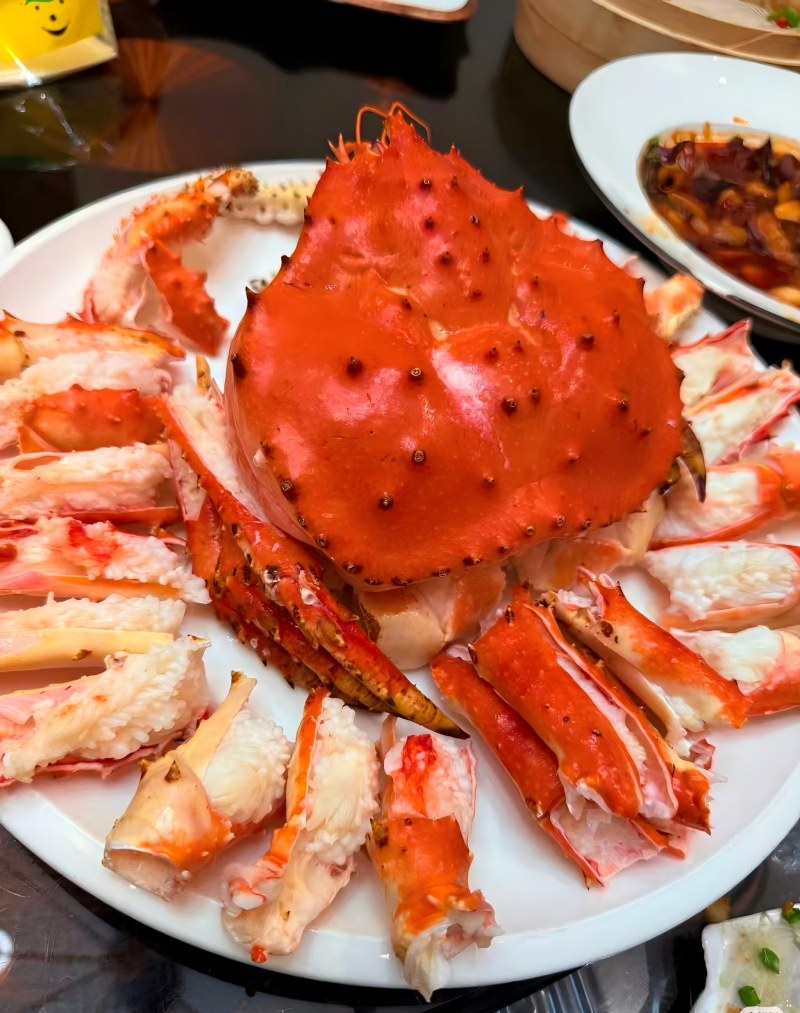
As the New Year's Day holiday approaches, the domestic high-end seafood market is experiencing a consumption peak, and live king crabs have become the "new favorite" of the New Year's flavor on the dining table. A reporter learned from the Jeminay Port in Xinjiang that as of December 22nd, the trade volume of imported live king crabs in Xinjiang this year has exceeded 100 million yuan, showing a significant increase compared with the same period last year.
As the only customs clearance port in the northwest region of China with the qualification to import live king crabs, the Jeminay Port has achieved a leap from "zero breakthrough" to "billion-yuan level" within just one year. Since the first batch of king crabs were imported in October 2024, the local area has gradually developed into an important channel for seafood trade between China and Russia, relying on its unique geographical advantages and complete port infrastructure.
It is understood that currently, the king crabs entering through the Jeminay Port mainly come from the Russian Far East and the Barents Sea. After completing quarantine and customs clearance, these crabs will be processed in two categories: some will be directly sent to the major consumer markets in the mainland, while the other part will be placed in professional temporary breeding ponds within the supervision area for short-term care. The temporary breeding pool simulates the environment of the original Arctic Ocean, strictly controlling the water temperature between 0 and 1 degrees Celsius to ensure the survival rate and vitality of king crabs during transportation and storage. After receiving the order, the king crabs can be quickly delivered to the catering and retail terminals in Beijing, Shanghai, Guangzhou and other places through cold chain logistics.
Industry insiders say that as domestic consumers' acceptance of high-end seafood keeps increasing, the demand for live king crabs in the market continues to expand. Xinjiang, with its geographical advantage, has become an important node for Russian seafood to enter China by land. Compared with traditional sea transportation, live king crabs imported through the Jimunai Port have shorter transportation time, lower loss rate and a more efficient and stable supply chain
To ensure the rapid customs clearance of live seafood, the local customs department has introduced a number of convenient measures in quarantine inspection, logistics dispatching and information declaration and other links. A relevant official from Jeminay Customs introduced that currently, the import declaration of king crabs has been fully digitized, and the average customs clearance time has been reduced by more than 30%. Meanwhile, the supervision area is also equipped with a constant-temperature temporary breeding system, real-time monitoring equipment and emergency oxygen supply facilities to ensure the quality and safety of imported seafood throughout the entire transportation and storage chain.
At present, live king crabs imported through the Jimunai Port have formed a stable market network, mainly sold to core cities such as Beijing, Shanghai, Guangzhou, Chengdu and Hangzhou, and radiating to the high-end catering market in the surrounding areas. With the continuation of the trend of consumption upgrade, it is expected that the import volume of king crabs in Xinjiang will still maintain a growth momentum in 2026. The Jeminay Port is expected to become an important hub for high-end aquatic product trade connecting China, Russia and even Central Asia.