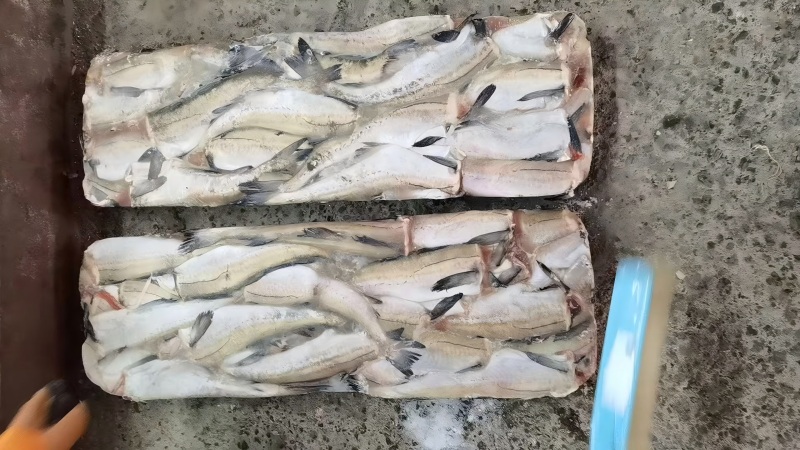
In the 38th week of 2026, the quotations of frozen Atlantic cod (Gadus morhua) H&G CIF in the Chinese market remained stable on the surface, but several changes have occurred at the origin end. The loosening of auction prices in Norway, the sharp drop in trawling catches, and the continuously widening price gap between sanctioned and non-sanctioned Russian sources are putting pressure on subsequent quotations in the Chinese market.
In the 38th week, the CIF price assessment of frozen H&G Atlantic cod from Norway and Russia in China remained basically stable week-on-week. The current biggest price support for Norwegian supplies comes from the scarcity of supply, but signs of loosening have already emerged in the auction market in the 37th week.
In the 37th week, the average auction price of 1-2.5 kilograms of frozen H&G Atlantic cod dropped to 85.26 Norwegian kroner per kilogram, with a transaction volume of only 302.9 tons. Some transaction prices have dropped to the middle range of 80 Norwegian kroner per kilogram. The market transactions included B-grade and non-MSC-certified Greenlande-caught fish, so this price cannot be directly understood as a comprehensive decline in standard Norwegian MSC products. However, the loosening of auction prices has become a signal of concern for Chinese buyers.
Public data from the Norwegian white fish market also shows that the current supply of cod is not abundant. According to data from the Norwegian Seafood Council, 117 tons of fresh wild cod were exported in the 37th week, with an average price of 86.56 Norwegian kroner per kilogram. From the beginning of the year to the 37th week, a total of 9,216 tons were exported, with an average price of 96.49 Norwegian kroner per kilogram. So far this year, 14,316 tons of frozen whole cod have been exported, with an average price of 103.85 Norwegian kroner per kilogram.
Data released by the Norwegian Fisheries Sales Organization for the 37th week shows that the transaction volume of fresh raw materials was approximately 95 million Norwegian kroner, of which cod contributed 26 million Norwegian kroner and haddock contributed 7 million Norwegian kroner. In the 37th week, the trading volume of fresh cod was 513 tons. Different fishing gear such as purse Seine trawling, longline fishing and gill nets were all used for fishing, but the overall trading volume was already lower than that of the same period last year.
The supply contraction at the trawl end is even more pronounced. In the 37th week, the Norwegian trawler fleet's weekly output of Atlantic cod was only 47 tons, a year-on-year decrease of 96%. The cumulative catch over the past four weeks was only 681 tons, a year-on-year decrease of 78%. The trawling catch from the beginning of the year to now is approximately 17,937 tons, a year-on-year decrease of 26%.
The short-term supply of haddock (Melanogrammus aeglefinus) has also dropped sharply. The trawling catch in the 37th week was only 1 ton, compared with 449 tons in the same period last year. However, due to the good fishing performance in the first half of the year, the cumulative trawling volume from the beginning of this year to now still reached 23,448 tons, an increase of 13% year-on-year. The catch over the past four weeks has dropped by 72%, and the supply contraction has expanded from weekly data to recent cumulative figures.
From the perspective of the entire Norwegian fleet, the tightening of Atlantic cod supply has a clear quota basis. The adjusted total quota for 2026 is 143,304 tons, a year-on-year decrease of 18%. The total catch in the 37th week was 474 tons, a year-on-year decrease of 70%. Since the beginning of the year, a total of 117,208 tons have been caught, a year-on-year decrease of 16%. The remaining quota is approximately 26,096 tons, a 27% decrease compared to the same period last year.
There is another kind of pressure on the supply from Russia. In the 38th week, the CIF price of 1-2 kilograms of EU-approved goods in China changed little, but the price gap between sanctioned and non-sanctioned enterprises has widened to approximately 700 to 900 US dollars per ton. After low-priced Russian supplies entered the Chinese market, the bargaining space for other suppliers was significantly squeezed.
The black cod market has also shown a similar divergence: the price of Russian sources has weakened, while the quotations of Norwegian sources have remained relatively stable, but the trading volume is very limited. Price stability does not necessarily mean active market trading. On the contrary, it might be because the trading volume is too low and the quotations have not yet formed sufficient market discovery.
The appreciation of the Norwegian krone this year has further increased the purchasing costs for Chinese buyers. For auction supplies priced in Norwegian kroner, even if the origin price fluctuates only slightly, the actual purchase cost after conversion to US dollars or RMB will still be affected by the exchange rate.
Therefore, in the 38th week, a rather special situation emerged in the Chinese Atlantic cod market: the Norwegian supply lacked significant room for price reduction due to low catch, while the auction end had already shown signs of loosening. Russian supplies have been affected by sanctions price differences and competition from low-priced sources. Market quotations have remained stable for the time being, but transaction activity is limited.
The global cod trade itself is also in a supply contraction cycle. The Food and Agriculture Organization of the United Nations previously pointed out that the global import volume of frozen cod was approximately 560,000 tons in 2025, a decrease of about 85,000 tons compared with the previous year. China remains the largest market for frozen cod imports. In 2026, the quota for Northeast Arctic cod will continue to decline, and the tightening of supply remains an important backdrop for the global cod market.
In the 38th week, there was no significant decline in CIF prices in the Chinese market for the time being, but changes in the Norwegian auction end have already provided new price signals. If auction prices continue to weaken and low-priced Russian sources continue to expand their market share, the current stable state of Chinese CIF quotations may face adjustments.