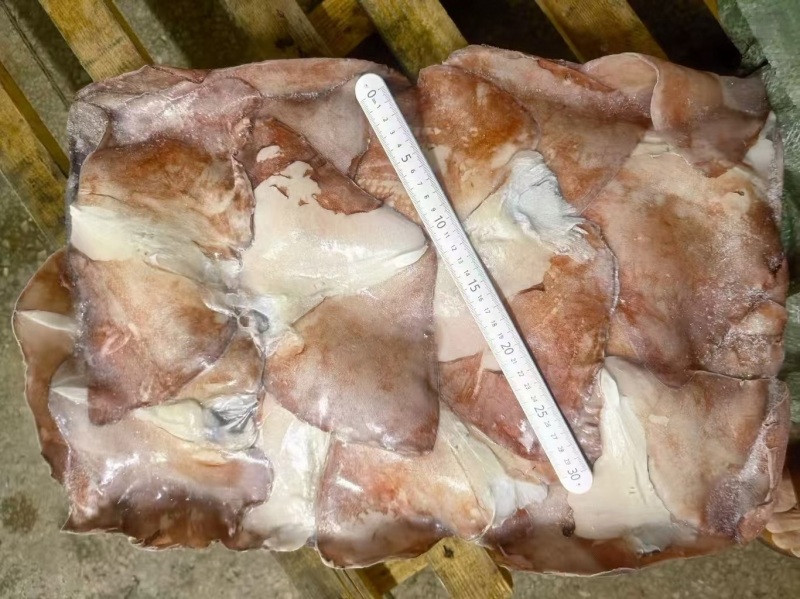
In the 42nd week (October 12th to 16th, 2026), trading gradually resumed after the National Day holiday. The comprehensive quotations of all production areas of distant-water squid monitored by the Zhejiang Zhoushan International Agricultural Products Trade Center (hereinafter referred to as Zhejiang Agricultural Center) remained unchanged across the line. Peruvian squid large whole strips (over 2000 grams) are quoted at 10,800-11,500 yuan per ton. Since the adjustment was in place in the 38th week, it has remained unchanged for five consecutive weeks. Argentine squid (off-line) of 300-400 grams is quoted at 40,000-41,000 yuan per ton, remaining at a high level.
Peru's quota is coming to an end. Data from the Directorate General for Supervision, Inspection and Sanctions (DGSFS-PA) under the Ministry of Fisheries and Aquaculture shows that as of October 15, the cumulative unloading volume of Peruvian squid (Dosidicus gigas, locally known as "Pota") reached 700,116.77 tons, completing 98.66% of the annual quota for 2026, with the remaining quota being less than 10,000 tons. Entering October, the fishing progress of small fishing vessels with a cargo hold capacity of less than 10 cubic meters has slowed down. Since the start of the phased fishing season, they have only completed 33.92% of the quota approved from October 1st to December 31st. The weekly report indicates that the Marine environmental changes related to El Nino have affected sea water temperature and resource distribution. There is still uncertainty regarding the subsequent fishing progress and raw material supply. Last week, the production at the high seas fishery was quite good, with an average daily output of 5 to 8 tons per vessel. Since December 2025, the average catch per vessel has been approximately 950 to 1,000 tons.
On the Argentine side, the fishing of Argentine squid (Illex argentinus) in the exclusive economic zone and the high seas has been completed. In the 42nd week, the off-line quotations remained at a high level: 40,000-41,000 yuan per ton for 300-400 grams, 40,500-41,500 yuan per ton for 400-600 grams, and 40,500-42,000 yuan per ton for over 600 grams. The Zhejiang Agricultural Center platform saw an online transaction volume of 94 tons. In terms of the fleet, the Argentine shipyard Tandanor recently completed the maintenance and repair of three squid fishing vessels, Hu Shun Yu 6, Hu Shun Yu 7, and Hu Shun Yu 8. Each of the three vessels is 70 meters long and 10 meters wide. The maintenance covered the inspection of the propulsion system, the maintenance of the hull structure, equipment calibration, and non-destructive testing. Tandanor said that the planned maintenance of the three vessels has been completed, but when they will be put into the new season of fishing still depends on the arrangements of the shipowners, relevant approvals and the decision of the Argentine Federal Fisheries Commission (CFP) on the new season of fishing.
The price of Indian Ocean squid remained unchanged for the 42nd week, with the 100-300 gram specification quoted at 13,000 to 13,600 yuan per ton. The first batch of fishing boats have set off one after another and are expected to enter the new season of fishing after arriving at the operation area. This year's Indian Ocean fishing moratorium is from July 1st to October 15th, which is 15 days later than in previous years. The quotations for Northwest Pacific squid remain stable, with those weighing less than 300 grams quoted at 21,000 to 23,000 yuan per ton.
In terms of customs clearance, the volume of self-caught squid from the sea at Zhoushan Port increased significantly in the 42nd week (October 9th to 15th, 2026) compared with the previous week. After the Spring Festival, the supply began to enter the domestic market.
The weekly report observation section of Zhejiang Agricultural Center mentioned that after the National Day holiday, market transactions gradually resumed, but downstream purchases have not significantly increased, and prices have not yet shown an overall rise or fall. According to the weekly report, the short-term market is expected to operate steadily with local fluctuations in specifications. If the post-holiday procurement recovery is slow and new supplies continue to enter the market, the balance between supply and demand in the market may come under pressure, and prices may face downward pressure. If the willingness to make deals improves and downstream purchases increase, the digestion of supply sources is expected to accelerate. The key tracking points listed in the weekly report include the fishing situation in major production areas, customs entry data, changes in platform transactions, and the price performance of different specifications.
The price data in this article is sourced from the Zhejiang Zhoushan International Agricultural Products Trade Center and collected from public channels. It only represents the transaction prices of different specifications and qualities in a single market. The prices may vary due to differences in product quality and origin.